
If you’re lying awake at night listening to your husband (or wife) snore, you’re probably less interested in why snoring happens and much more interested in one question:
How can I make him stop?
You may have tried nudging him. Rolling him onto his side. Earplugs. Going to bed first. Or perhaps, eventually and regrettably, one of you has moved into the spare room.
Snoring can be incredibly frustrating for the person sleeping next to the rumbling. But there is another reason we think persistent snoring is worth investigating.
At 123 Dental, we’re interested in more than just looking after your teeth. We want to help our patients (and their partners) maintain their overall health and wellbeing for the long term.
And sometimes snoring can be a sign that something more important is happening while you sleep.
Why do people snore?
When we’re asleep, the muscles around our upper airway relax. As air passes through a narrowed air-way, the surrounding tissues can vibrate, producing the sound we recognise as snoring.
There are lots of reasons this can happen. Weight, alcohol, sleeping position, nasal obstruction and the anatomy of the jaws and airway can all play a role.
For some people, snoring is primarily a social problem.
For others, however, the airway doesn’t just narrow enough to make a noise. It can repeatedly become partially or completely obstructed.
This is Obstructive Sleep Apnoea, or OSA.
The distinction matters. In obstructive sleep apnoea these episodes can happen repeatedly during the night, disrupting normal sleep and sometimes causing oxygen levels to fall.
Could his snoring be sleep apnoea?
Not everybody who snores has sleep apnoea.
But snoring is one of the common signs we look for.
Other things worth paying attention to include:
- pauses in breathing noticed by a partner, gasping or choking during sleep;
- waking feeling unrefreshed despite apparently having had enough sleep;
- excessive daytime sleepiness;
- morning headaches or a dry mouth;
- restless sleep; and
- difficulties with concentration, memory, mood or irritability.
Interestingly, this is one area where the partner can be incredibly useful.
The person snoring may have absolutely no idea what is happening because they’re asleep. Their part-ner may be the one who notices the snoring becoming louder, pauses in breathing, gasping, choking or restless sleep.
Why are we interested in this at a dental practice?
Looking after someone’s health isn’t limited to making teeth last.
Dentists spend a lot of time examining the mouth, jaws and surrounding structures. We’re also in a position to ask questions about things such as snoring, sleep and grinding that may sometimes point towards a wider problem.
Obstructive sleep apnoea is important because untreated OSA is associated with problems including high blood pressure, cardiovascular disease and stroke, as well as daytime sleepiness, impaired con-centration and mood changes.
It may also be associated with people grinding or clenching their teeth, which can contribute to dental wear and damage.
This is part of the reason sleep interests us at 123 Dental. We don’t see the mouth as something com-pletely separate from the rest of the person.
So, how can you stop snoring?
There isn’t one treatment that’s right for everybody because there isn’t one cause of snoring.
Depending upon the person, measures may include losing weight where appropriate, reducing alcohol, particularly close to bedtime, treating nasal obstruction, changing sleeping position, CPAP when indi-cated, and oral appliance therapy.
And this brings us to an area where dentistry can sometimes help.
What is a mandibular advancement splint?
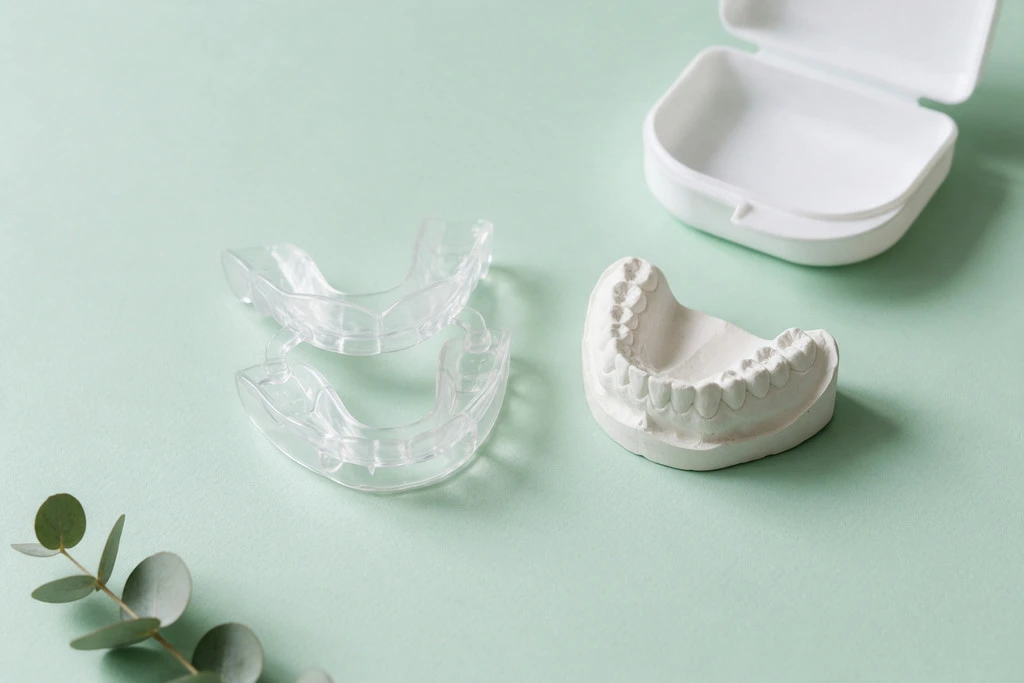
A mandibular advancement splint, usually abbreviated to MAS, is a custom-made dental appli-ance worn while you sleep.
It looks a little like a mouthguard, although what it does is quite different.
The appliance holds the lower jaw in a more forward position. This can increase the space behind the tongue and help maintain a more open airway while you’re asleep.
By improving the airway, an MAS can reduce the vibration that causes snoring and, in appropriately selected patients, reduce obstructive breathing events.
Do mandibular advancement splints actually stop snoring?
For many people, they can make a substantial difference.
Research has shown 95% of patients experienced some decrease in their level of snoring with mandibular advancement splint treatment.
That’s an encouraging figure, but I think it’s important to explain individual response varies.
That is also why we prefer a custom-made, adjustable appliance rather than simply buying a ge-neric “anti-snoring mouthguard” online.
What if it’s actually sleep apnoea?
This is the really important bit.
We don’t want to make the snoring disappear and ignore the reason it was happening.
If someone’s history suggests possible obstructive sleep apnoea, we believe it should be properly in-vestigated before simply assuming that a snoring appliance is the answer.
And there is an important distinction in roles here.
A dentist isn’t there to diagnose obstructive sleep apnoea.
Instead, we work as part of a team.
Our role is to identify patients who may need further investigation and, where appropriate, provide and manage an oral appliance as part of their treatment.
Working with Somnocare to get the diagnosis right
At 123 Dental, we partner with Somnocare in West Leederville for sleep assessment and testing.
We think this part is important.
Our philosophy isn’t:
“You snore, so let’s make you a splint.”
It’s:
“You snore. Let’s first understand why.”
Where a diagnostic sleep study is appropriate, we believe in using a sufficiently comprehensive inves-tigation to give the medical team the information they need to make an appropriate diagnosis and treatment recommendation.
Depending on the individual patient, this may involve a Level 1 or Level 2 sleep study.
A Level 1 study is an attended sleep study performed in a sleep laboratory, with a technician present. A Level 2 study collects comprehensive sleep and breathing information but can be performed unat-tended, usually allowing the patient to sleep in their own home.
Importantly, these aren’t simply devices that record whether you snore or measure your oxygen level.
Level 1 and Level 2 studies can record multiple aspects of sleep and breathing, allowing things such as breathing interruptions, oxygen levels, sleep stages and arousals to be properly assessed.
We like this approach because getting the diagnosis right is what allows us to choose the right treatment.
Sometimes that treatment might involve a mandibular advancement splint.
Sometimes CPAP may be more appropriate.
Sometimes another problem needs investigating.
The important thing is that we haven’t simply treated the noise and potentially missed what is causing it.
Does Medicare cover the sleep study?
For eligible patients, Medicare can cover a significant proportion of the cost of a diagnostic sleep study.
There are specific eligibility and referral requirements.
One Medicare pathway uses recognised screening questionnaires such as the Epworth Sleepiness Scale together with STOP-Bang Questionnaire. Alternatively, a sleep or respiratory physician can de-termine that a diagnostic sleep study is clinically necessary following their assessment.
There may still be an out-of-pocket cost and eligibility varies, so we wouldn’t promise that every pa-tient’s study will be covered. But for patients who meet the criteria, Medicare may cover a substan-tial part of the investigation.
Is a mandibular advancement splint better than CPAP?
It’s not really a question of one treatment being universally “better”.
CPAP is generally more effective at reducing the number of obstructive breathing events, par-ticularly in more significant OSA.
Oral appliances, however, can be an effective alternative for appropriately selected patients, particular-ly for snoring and some patients with OSA, including people who cannot tolerate CPAP or prefer an alternative therapy.
The evidence discussed in our course is particularly interesting here. While CPAP produced greater reductions in measures such as AHI and oxygen desaturation, titratable mandibular advancement splints produced similar improvements in sleepiness and quality of life in some studied patients, while adherence and patient preference tended to favour MAS.
That’s why treatment needs to be individualised rather than ideological.
The best treatment is one that’s appropriate for your condition, effective for you and that you can actu-ally use consistently.
Is a snoring splint just a mouthguard?
No.
A properly prescribed mandibular advancement splint needs considerably more thought than simply taking an impression and making a piece of plastic.
Before recommending one, we need to assess your teeth, gums, existing dental work, jaw joints, bite and how far your lower jaw can comfortably move.
The appliance then needs to be fitted and gradually adjusted to find a position that provides an effec-tive result while remaining comfortable.
Possible side effects include temporary tooth or jaw tenderness, increased salivation or dry mouth, and over the longer term some people can experience changes to their tooth positions or bite.
That’s one of the reasons we continue to review patients rather than simply handing over an appliance and saying goodbye and monitoring will form part of your regular check ups.
What would happen at 123 Dental?
If you, or perhaps your sleep-deprived partner, come to us because of snoring, our goal isn’t to sell you a splint.
It’s to work out what problem we’re actually trying to solve.
We’d want to understand your snoring and your sleep. Has your partner noticed pauses in your breathing? Do you gasp or choke? Do you wake refreshed? Are you excessively sleepy during the day?
If we think further investigation is appropriate, we can work with SomnoCare and the medical team to help arrange an appropriate sleep assessment.
If a sleep study identifies obstructive sleep apnoea, the results can then be considered medically and the appropriate treatment options discussed.
If a mandibular advancement splint is recommended and you’re dentally suitable, that’s where our role becomes particularly important. We can design and fit a custom appliance, gradually adjust it and monitor both its effectiveness and its effects on your teeth, bite and jaw.
And if things aren’t improving as expected, we don’t simply keep advancing the appliance indefinitely. Persistent snoring or symptoms may warrant further assessment by the sleep physician or an ENT specialist.
So, what can I do about my husband’s snoring?
Start by taking it seriously, but don’t panic.
Snoring is extremely common and doesn’t automatically mean your partner has sleep apnoea.
But if it’s persistent, particularly if you notice pauses in breathing, choking or gasping, or if they are is regularly tired despite apparently sleeping all night, it’s worth investigating rather than simply accepting it.
And yes, a mandibular advancement splint may be part of the answer.
But we’d rather establish that it’s the right answer first.
Because at 123 Dental, our aim isn’t just to make your partner quieter.
It’s to help them sleep well, look after their health (and teeth) and, hopefully, help you get a decent night’s sleep too!